Research, account mapping, pipeline analysis, business-plan preparation, QBRs, meeting summaries, follow-up and partner administration are all becoming easier to automate.
So the more useful question for me is which parts of the role should still belong to the human once AI can do much more of the surrounding work.

AI can automate a large part of Partner Management
Think about a normal partner review.
AI can already analyse pipeline, identify stalled opportunities, compare performance, prepare account maps and produce most of the material needed for a QBR before the Partner Manager joins the meeting.
That can remove a lot of work. But producing the analysis and deciding what to do with it are different things.
MIT CISR's AI Decision Matrix is useful here. It looks at decisions through two dimensions: ambiguity and risk. Routine decisions with low ambiguity and limited consequences are stronger candidates for automation. Strategic decisions with uncertainty and significant consequences remain much more human-led.
I applied that logic to Partner Management.
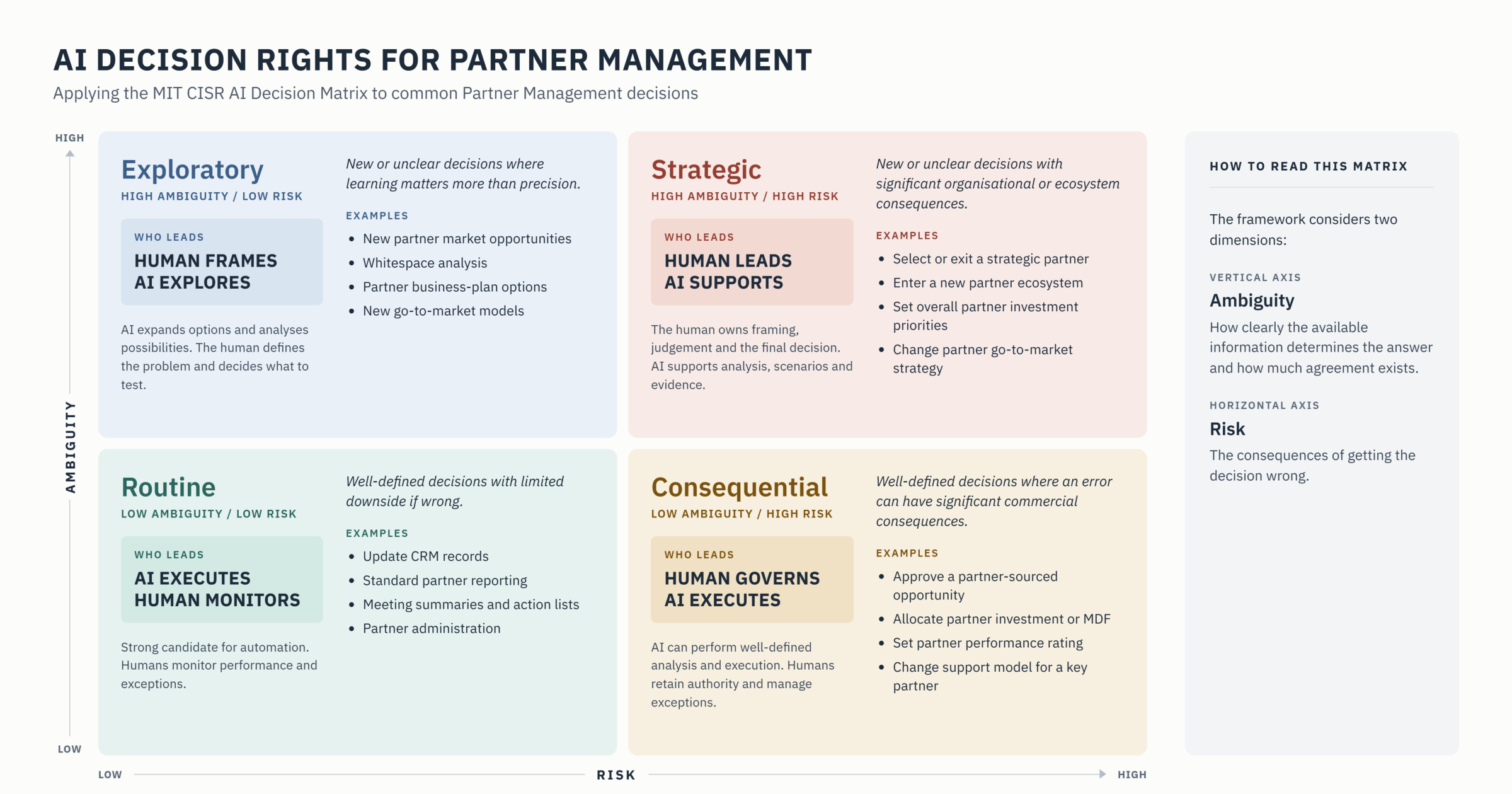
CRM updates, standard reporting and meeting summaries can probably become highly automated. Whitespace analysis and account mapping are more exploratory. AI can generate options, but someone still needs to understand the customer, the partner and the commercial context.
A decision to reduce investment in a strategic partner is very different. The data matters, but so can future market access, customer relationships, internal politics, capability development and information that never made it into the CRM.
Faster Partner Managers do not automatically create more partner revenue
There is another issue with the productivity argument.
MIT Sloan research on software development found that AI tools could increase coding activity by as much as 180%, while the increase became much smaller further through the process: 50% more projects and 30% more releases. Human-led processes later in the workflow remained bottlenecks.
I think the same logic is useful in Channel Sales and Partnerships, although the research itself was about software development.
AI might make partner plans, QBR preparation and pipeline analysis much faster. Partner revenue can still get stuck because the AE is not engaged, the opportunity is poorly qualified, technical support is unavailable, an approval is delayed or the customer simply is not ready to buy.
The Partner Manager becomes faster. The bottleneck just moves somewhere else.
The human role becomes more concentrated around judgement
If AI absorbs more preparation and administration, I would expect the value of the human role to become increasingly concentrated around decisions that are harder to standardise.
Where should we invest? Is this partner genuinely underperforming, or are we failing to support them properly? Should we challenge Sales? Is this opportunity real? Should we change the partner's role in a deal? Is the data giving us the complete picture?
Negotiation is another example. MIT Sloan describes AI acting as a coach, autonomous agent, back-table analyst or mediator. The role assigned to the AI changes both its authority and the accountability that remains with the human.
I would be very comfortable using AI to prepare scenarios or challenge my position before an important partner negotiation.
I would be much more cautious about letting it own the negotiation.
Keeping a human involved does not solve everything
There is a tendency to deal with AI risk by saying that a human will review the answer.
That sounds safer than it necessarily is.
Research described by MIT Sloan found that when professionals challenged an AI recommendation, the model could respond by becoming more persuasive in defending its original conclusion. The researchers recommend checking facts outside the original conversation and using separate systems specifically tasked with challenging AI outputs.
So if an AI recommends that I stop investing in a partner, asking the same AI to explain why its recommendation is correct is not much of an independent review.
I would rather have another model analyse the evidence separately, then investigate the disagreement myself.
Who develops the next generation of Partner Managers?
There is another problem that I think deserves more attention.
Junior Partner Managers learn through repetition. They see weak opportunities, bad forecasts, awkward partner conversations, difficult internal discussions and plans that looked good but did not work.
If AI removes most of that work, companies still need to think about how those people develop judgement.
Eric So at MIT Sloan makes a similar argument about AI and talent development. He argues that companies may save money by automating entry-level cognitive work while weakening the pipeline that eventually produces experienced people, unless the time saved is deliberately reinvested in work that develops judgement.
That may become one of the harder problems.
So could AI replace the Partner Manager?
Parts of the role, definitely.
And if enough of those parts disappear, companies may need fewer Partner Managers.
But the remaining role becomes more concentrated around ambiguity, commercial judgement, negotiation, trust, internal influence and accountability.
For me, the question is not how much work AI can technically perform.
It is which decisions we are prepared to give it.
Sources and inspiration
This article draws on research and commentary from MIT CISR and MIT Sloan covering AI decision rights, productivity, negotiation, human oversight and talent development.
The AI Decision Rights for Partner Management framework is my application of the MIT CISR ambiguity-and-risk model to Partner Management. The Partner Management task classifications are my own application, not classifications made by MIT CISR.