A vendor and a partner can have a signed agreement, executive sponsorship and an ambitious joint business plan, but still struggle when an important commercial decision needs to be made.
For example, the partner commits to organising a customer workshop, but the vendor has not approved the technical resources. The Account Executive wants to confirm a date, the partner is waiting for an answer, and the Alliance Manager is trying to coordinate people who report to different managers.
Who is actually responsible for making the decision?
This is where strategic alliance governance becomes important. It establishes how the organisations make decisions, assign responsibilities, manage commitments and resolve disagreements.
The Association of Strategic Alliance Professionals (ASAP) includes governance and decision-making as part of its alliance management framework.
I agree with that approach, but I would want to see how those arrangements work when Sales, Marketing, technical teams or management need to make decisions that affect the partnership.

Agree who can make which decisions
I would start by identifying the people who can actually commit resources, approve commercial exceptions and resolve disagreements in each organisation.
An Alliance Manager may prepare a business case, coordinate several teams and recommend a particular course of action. That does not necessarily mean they have the authority to approve the investment or allocate the resources.
The same distinction applies to executive sponsors. Having a senior executive involved is useful, but their responsibilities need to be clear. Are they approving investment, resolving competing priorities or helping the alliance obtain a decision from another part of the organisation?
In an ASAP discussion on technology alliance governance, Norma Watenpaugh recommends using a short team charter to establish the alliance's purpose, responsibilities and decision ownership.
I think this is a sensible starting point, provided the people named in the charter understand and accept those responsibilities.
Sales management is particularly important. If an alliance depends on Account Executives developing opportunities with partners, their managers need to support the arrangement and understand what their teams are expected to contribute.
The partner's Sales leadership should be equally involved. A commitment made by the Partner Manager is difficult to deliver if the people controlling the required resources have not agreed to it.
What the Belden case tells us about alliance governance
A useful example comes from the July 2026 MIT CISR case study of Belden, written by Martin Mocker and Ina M. Sebastian.
Belden was moving from selling industrial networking components towards providing more complete technology solutions with partners such as Accenture, NVIDIA and AWS.
That required changes to its internal Sales organisation, not just new partnership agreements.
The researchers describe how following up a lead from an ecosystem partner could initially involve around a dozen people from different functions.
Belden subsequently introduced smaller regional go-to-market teams, bringing together a partner salesperson and a solution salesperson. These teams helped establish which partner would lead an opportunity, who needed to participate and how the customer requirements would be addressed.
The company also changed its sales incentives to encourage cooperation on larger solutions rather than rewarding salespeople exclusively for the revenue generated by Belden's own components.
I find this particularly relevant because it demonstrates that alliance governance depends on how the vendor operates internally.
If Sales incentives, responsibilities and decision-making processes do not support working with partners, even a well-designed alliance strategy will struggle.
Of course, the Belden case describes a transformation that was still progressing. The researchers did not establish that the new model had already delivered all its expected financial returns. But the organisational changes provide a useful example of how a company can adapt its commercial operations to support ecosystem selling.
A practical alliance decision and escalation matrix
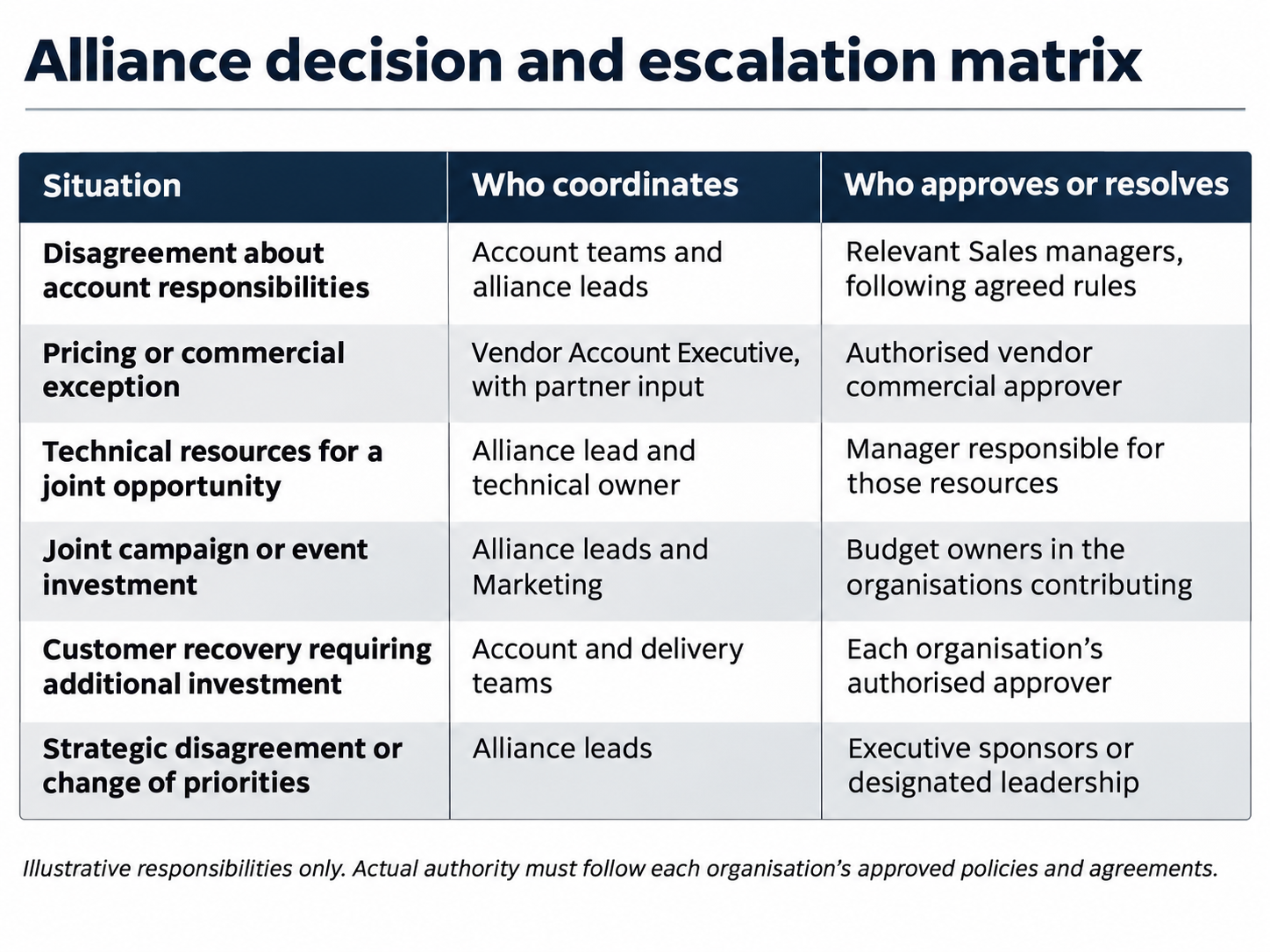
I would establish a simple decision matrix covering the situations most likely to affect customer opportunities or require resources from both organisations.
-
Disagreement about account responsibilities
Who coordinatesAccount teams and alliance leads
Who approves or resolvesRelevant Sales managers, following agreed rules
-
Pricing or commercial exception
Who coordinatesVendor Account Executive, with partner input
Who approves or resolvesAuthorised vendor commercial approver
-
Technical resources for a joint opportunity
Who coordinatesAlliance lead and technical owner
Who approves or resolvesManager responsible for those resources
-
Joint campaign or event investment
Who coordinatesAlliance leads and Marketing
Who approves or resolvesBudget owners in the organisations contributing
-
Customer recovery requiring additional investment
Who coordinatesAccount and delivery teams
Who approves or resolvesEach organisation's authorised approver
-
Strategic disagreement or change of priorities
Who coordinatesAlliance leads
Who approves or resolvesExecutive sponsors or designated leadership
| Situation | Who coordinates | Who approves or resolves |
|---|---|---|
| Disagreement about account responsibilities | Account teams and alliance leads | Relevant Sales managers, following agreed rules |
| Pricing or commercial exception | Vendor Account Executive, with partner input | Authorised vendor commercial approver |
| Technical resources for a joint opportunity | Alliance lead and technical owner | Manager responsible for those resources |
| Joint campaign or event investment | Alliance leads and Marketing | Budget owners in the organisations contributing |
| Customer recovery requiring additional investment | Account and delivery teams | Each organisation's authorised approver |
| Strategic disagreement or change of priorities | Alliance leads | Executive sponsors or designated leadership |
These are illustrative responsibilities. Every organisation has its own approval processes, and those still need to be respected.
The important part is identifying the actual decision-makers and agreeing on an escalation route before a disagreement becomes a problem.
I would also establish a deadline for each outstanding decision and make someone responsible for communicating the outcome.
Telling a partner that something is being discussed internally is understandable for a short period. But if the same explanation continues for weeks without a clear next step, the partner may begin questioning how seriously the vendor is taking the relationship.
A decision should not be presented as approved simply because the Alliance Manager or Account Executive believes it is likely to receive approval.
Avoid governance becoming another obstacle
There is a risk that companies respond to difficulties in an alliance by creating additional meetings, committees and approval requirements.
A Baringa case study published in June 2024 describes governance problems within an oncology alliance between two global pharmaceutical companies.
The consultancy identified one decision that required 36 governance interactions before it could be made.
Baringa recommended reducing those interactions, delegating appropriate decisions and establishing clearer boundaries between the two organisations' governance processes.
This is a pharmaceutical industry example, and the findings should not automatically be treated as representative of technology alliances. But the underlying problem is relevant.
If every decision needs to be reviewed by several committees, the alliance may become slower than either organisation working independently.
I would prefer to resolve operational problems at the lowest appropriate level, with clear escalation when the people involved cannot reach a decision.
Vantage Partners makes a similar argument, recommending joint escalation when necessary rather than allowing each organisation to take its complaints separately through its own management structure.
That makes sense to me. When a problem affects both organisations, I would rather see the Alliance Managers agree on the facts, identify the options and bring a recommendation to the relevant decision-makers.
For example, if a customer opportunity requires additional investment, the escalation should explain what has changed, the costs involved, the commercial risks and who needs to approve the proposed recovery.
I have discussed a similar situation in When a Customer Solution Changes, Who Owns the Recovery?.
The Alliance Manager may end up doing much of the coordination, but that should not become an excuse for other teams to avoid their responsibilities.
Make joint business plans and reviews useful
I would use governance meetings to review actual commitments and commercial progress, rather than simply report activities.
For an established alliance, opportunity reviews should address customer requirements, sales responsibilities and immediate blockers. Regular operating reviews should examine the joint business plan, resources committed by both organisations and problems affecting several opportunities.
Executive reviews should focus on strategic priorities, investment decisions and issues that cannot reasonably be resolved by the operating teams.
Not every alliance needs the same meeting frequency. A large international strategic alliance will have different requirements from a focused partnership operating in one country.
The vendor's CRM should contain the relevant opportunity information, while meeting summaries and a shared action log should identify what was agreed, who is responsible and when the next action is expected.
I would also distinguish between confirmed commitments and proposals that still require approval.
For example, a joint business plan may include a customer event, technical workshops or a marketing campaign. But if neither organisation has approved the budget or allocated the necessary resources, those activities are still intentions rather than firm commitments.
At each review, I would want to understand what both sides actually delivered.
Did the partner organise the agreed customer meetings? Did the vendor provide the promised technical support? Were opportunities properly qualified? Are they progressing? If something did not happen, what prevented it?
It is important to assess both organisations. A vendor cannot reasonably complain about weak partner engagement while repeatedly failing to provide the support it agreed to deliver.
Governance needs to result in decisions
I would not judge the quality of an alliance's governance by the number of meetings it holds or the seniority of the people attending them.
I would look at how quickly the organisations resolve problems, how consistently they meet their commitments and how well their internal teams cooperate when commercial decisions are needed.
Partners can accept difficult decisions, including a refusal to approve additional investment, provided the process is clear and the reasons are explained.
What becomes harder to manage is when decisions are repeatedly delayed, commitments are forgotten or previously agreed responsibilities keep changing without a proper discussion.
For me, that is the practical purpose of strategic alliance governance: making sure the two organisations know who is responsible, who has the authority to decide and what happens when something does not go according to plan.
And, just as importantly, making sure those decisions actually result in action.